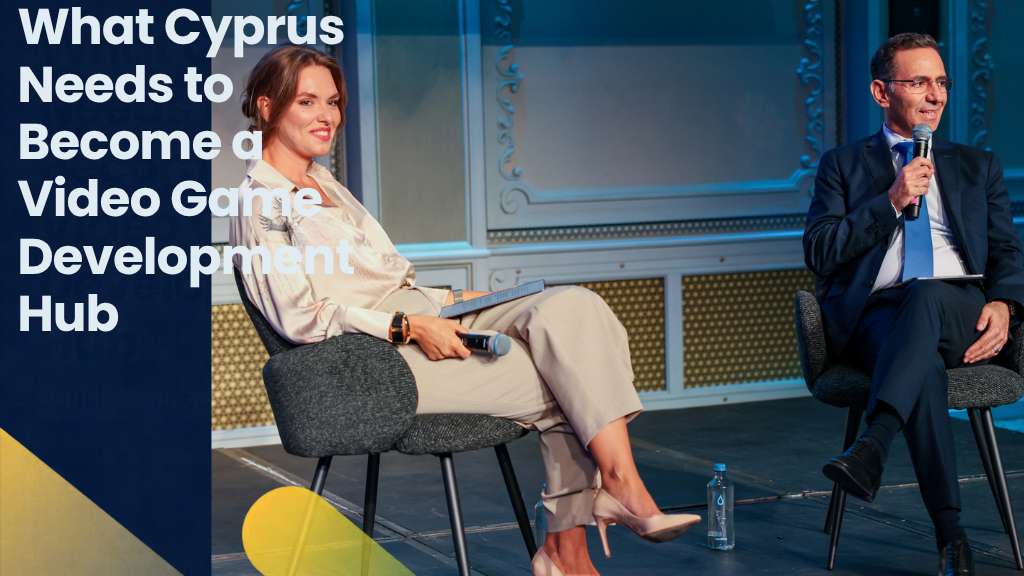
Last week I moderated a fireside chat with Nicodemos Damianou, PhD, Deputy Minister of Research, Innovation and Digital Policy. The title was "Cyprus as a Video Gaming Hub: What Comes Next?". Here is what I took away, and what I think it means for anyone building video games from this island.
What Cyprus has already built
Let's start with credit where it is due. According to the Cyprus Video Game Industry Report 2025 by CYGMA, the sector today counts around 415 companies, about 3.2 billion euros in annual revenue and over 4,300 professionals. Cyprus ranks first in the world per capita in the number of game companies, revenue and installs, and third in the world for mobile downloads, behind only China and Vietnam. The number of studios grew from 169 in 2019 to 393 in 2024, more than four times faster than the European average.
The names behind those numbers are ones the whole industry knows. Wargaming runs its global headquarters from Nicosia (board member of TechIsland® btw). Other big supporters of #TechIsland mission:
- GDEV, the Nasdaq-listed group behind Hero Wars, is based in Limassol.
- SayGames, the world's third-largest mobile publisher by downloads, publishes from Limassol and Paphos.
- MY.GAMES runs one of its largest offices here, and War Robots has passed a billion dollars in lifetime revenue.
- In 2025 Easybrain was sold to Miniclip for over a billion euros, the largest disclosed video gaming exit in Cyprus history.
When I talk to founders informally, they describe Cyprus as a world-class publishing hub and an excellent corporate jurisdiction. The government sees it in a broader frame: Cyprus moving from an almost entirely service-based economy to a knowledge and innovation economy, with a technology sector on top, a startup ecosystem feeding it, research and innovation underneath, and the business and policy environment holding it all up. Video gaming fits that picture unusually well. It is a full tech stack sector, it is export-oriented, and it is creative by nature. That combination is rare, and the government knows what it is worth.
The profit side and the cost side
The Deputy Minister's own assessment, which I share, is that Cyprus has one of the most attractive profit-side propositions in the world, possibly the most attractive. On the cost side, we are not doing what a handful of competing jurisdictions do.
Look at what our incentives actually do, through two studios that could both be sitting in that room.
The first studio has a live title and 2 million euros of profit from its own game IP. Under the IP Box, 80% of that profit is exempt, so only 400,000 euros are taxed at the new 15% corporate rate. The tax bill is 60,000 euros instead of 300,000, an effective rate of 3%. Add the 50% income tax exemption for the senior hires it brings in on salaries above 55,000 euros, and the non-dom regime for its founders, and it is hard to find a better place in Europe to run a profitable studio.
The second studio is two years from launch. It spends 2 million euros a year on developers, with no revenue yet. The 120% R&D super-deduction lets it write off 2.4 million against taxable profit, but it has no profit to write anything off against. The benefit sits in its accounts as a carried-forward loss and only turns into real money once the game earns. Even then, the extra 20% is worth 60,000 euros of tax at 15%, and it arrives years after the cost was paid. Its biggest costs after launch, user acquisition and marketing, are not covered by anything at all.
Same island, same framework, two very different experiences. Almost everything Cyprus offers rewards a company that already earns. That is why companies register here, publish from here and book their revenue here, and why so much of the actual development still happens somewhere else.
The countries competing with us for studios chose the opposite playbook. Germany is putting 125 million euros a year into a federal games fund from 2026. Turkey now reimburses up to half of user acquisition and marketing costs for exporting studios. The UK has run a Games Fund since 2015 and this year added a 30 million pound Games Growth Package on top of its 34% expenditure credit. All the European examples were cleared under the EU's culture exemption for state aid, a route the Deputy Minister acknowledged Cyprus has not used yet.
To be fair, he was just as clear about the limits. No country can offer the best tax treatment across every type of asset; economic stability, social stability and fairness across industries all come into play. I respect that.
My takeaway is simple. Publishing follows profit. Creation follows cost. If we want the next hit title developed here, not just monetised here, that is the gap to close.
Gap one: capital
One detail from the conversation shows how fast this market has moved. Two or three years ago, when the government was designing its blended-finance programmes, the discussion was about tickets of up to 2.5 million euros, which by European standards is Series A money. Today the same discussion is about Series B, in the region of 10 million. The industry outgrew the instrument in two years.
And yet the CYGMA Cyprus Game Makers Association report counts 137 million euros of equity raised across 72 rounds between 2020 and 2025, of which 40 were pre-seed and seed and only three were Series B or later. The largest single round on the island, Strikerz's 35 million euros in 2023, came from private and international investors. Private funds that back studios here do exist, GEM Capital, The Games Fund and Mika Games among them, and they matter, but a handful of funds cannot carry an industry of 415 companies.
When I put it to the Deputy Minister that we can barely name the venture capital funds operating in Cyprus, his answer was that the private capital is indeed missing, and in particular investors who specialise in video gaming, and the gap is disproportionate to the size of the activity here. I would add that this is not a video gaming problem at all. It is the state of the whole Cyprus venture market: we have a young pre-seed and seed layer, a thin Series A, and almost nothing beyond. Video gaming simply hits the ceiling first, because it grows fast enough.
The government has put several instruments on the table. 33East, the 26 million euro venture fund backed by the European Investment Fund, is already deploying. Plug and Play Cyprus, co-funded by the Deputy Ministry and the Research and Innovation Foundation, took its first cohort of ten startups in August. The newly legislated Cyprus Business Development Organisation is designed to close financing gaps for small and medium enterprises. And the RIF's own stack, from PRE-SEED through SEED at up to 500,000 euros, INNOVATE at up to a million and the DISRUPT and BOOST schemes matched to private investors, is fully open to video gaming studios.
The message I took from this part of the conversation is about roles. Public instruments can open the door at the earliest stages, and the Deputy Minister was clear that the government sees its job as creating the conditions for private, specialised investors to come in, rather than replacing them. That is a fair division of labour. It also means the next move is on the private side. With 415 studios, a billion-euro exit and a growing base of Series A companies, Cyprus now has the deal flow to support a dedicated video gaming fund, and I would love to see one built here.
Gap two: the cost of going global
Video game studios differ from other startups in one important way. For a mobile studio the biggest cost is not building the game, it is finding players. User acquisition and marketing can run at 40 to 50 percent of revenue, and platform commissions take another 30. In 2025 alone, private lenders committed over 128 million euros in user acquisition financing to Cyprus studios, almost as much as all the equity raised on the island in six years. Until now, no public instrument in Cyprus treated any of those costs as eligible.
That is changing. G3 - Games Go Global, a new Ίδρυμα Έρευνας και Καινοτομίας/Research and Innovation Foundation pilot, is the first instrument that recognises marketing, user acquisition, localisation, publishing readiness and publisher outreach as eligible expenses. It is small, but considered as first step: a 120,000 euro pilot, up to 30,000 euros per studio for four studios, covering half of eligible costs. But the design is not final. The market consultation is open until 30 September, and the ministry is explicitly asking founders to shape the parameters.
If you run a studio in Cyprus, this is the single most useful thing you can do this month.
Gap three: talent, and the Cyprus paradox
Here is the paradox. Cyprus is first in the world per capita in video gaming by every measure in the CYGMA report, yet our 13 universities produce between three and six graduates a year from a dedicated game development pathway, and realistically 10 to 40 hireable juniors, against demand the report puts at 100 to 300. And it is not only a video gaming problem. The fintech cluster next door employs 7,000 to 8,000 people and competes for the same few hundred graduates. It is the tech-wide talent constraint.
The government's response runs on three tracks: a horizontal push on STEM in schools, a Ministry of Education programme to align university curricula with real job market needs, and a new RIF pilot called Accelerate Cyprus Talent (ACT), which would place around 100 students inside high-growth tech companies for six-week paid internships and complement the existing PhD-in-industry and postdoc-in-enterprise schemes. ACT is in the same consultation, with the same 30 September deadline.
One more point from the conversation I fully agree with: companies train and reskill far faster than governments, and the government's job is to connect industry with universities rather than to produce talent on its own. The studios already partnering with our public universities are doing the most important work in this whole chapter. There is a retention side too. At TechIsland we have argued for years that if a relocated professional's partner cannot work, the talent leaves. Labour market access for spouses of highly skilled professionals (which we've advocated for and achieved successfully) is as much a talent policy as any university programme.
At TechIsland we are adding our own piece: a programme that puts working tech and video gaming professionals in front of 14 to 17 year olds in Greek-speaking public schools, plus a job-shadowing week for 16-year-olds inside real companies. More on that in October. The logic is simple. If a teenager in Paphos knows that a studio in Limassol is hiring, she will pick the right degree and come back. We have enough auditors and lawyers. We need people who build.
Gap four: rules that do not kill growth
The European rulebook for digital products is moving faster than at any point since GDPR. The Digital Services Act is in force. On 17 September the Commission presented the EU KIDS Act, which sets age-based access rules, parental management of accounts for under-15s and safety-by-design obligations, and which explicitly names online games alongside social media and AI chatbots. The Digital Fairness Act, targeting how digital products are designed and monetised, from dark patterns to loot boxes and in-game currencies, is expected before the end of the year. Three files, three different lead ministries inside our own government, all landing on the founders who were sitting in that room. Cyprus itself is moving in the same direction: the cabinet has approved a minimum age of 15 for social media, with a bill due in parliament in December.
The Deputy Minister was candid about the direction of travel. Europe will not step back from being the place that protects children first. What the government does want is proportionality: 27 different rule sets across 27 jurisdictions would kill growth, and simplicity and uniformity are what it will argue for. The door is open on the way there. The ministry is willing to hear the industry before positions go to the Council.
The industry, for its part, already self-regulates through PEGI, which labels in-game purchases including random items. What it needs from the next wave of rules is clarity and proportionality, not a fourth layer.
A bonus: compute
The question I get most often these days is how a tech company gets access to Pharos-CY, the Cyprus antenna of the Greek AI Factory, coordinated by The Cyprus Institute and connected to the Daedalus supercomputer. The short version: its priority areas are health, sustainability and culture and language, but any company can submit a request, a technical person is then assigned to assess which services fit, and the cost model is still being finalised. It is not a hosting environment for live operations. It is for research, experimentation and innovation. Submit a specific request and follow up on it. I will write a separate practical guide on this.
What success looks like
I asked the Deputy Minister where he wants video gaming in Cyprus to be in five years. The answer was not a number of companies or a share of GDP. It was this: if the companies sitting in that hall today are still here in five years, producing their breakthrough titles from Cyprus, the titles that take them to unicorn status, that is success.
I think that is the right definition. And it tells you what the next chapter is about.
Cyprus has built something rare: a jurisdiction that attracts. The next chapter is about creating here, not just registering here, and about keeping companies, not just bringing them in. The tools exist or are being designed right now, and for the first time the people designing them are asking the industry to hold the pen.
Three things you can do this month:
- respond to the G3 and ACT consultation before 30 September;
- tell us at TechIsland® what policies matter to you, because we are the ones advocating for tech sector;
- and if you are hiring, join our Minds in Cyprus delegation to the US in November and bring your job postings to the more than 750 Cypriots abroad who have already said they want to come home.
The registration phase is done. Let's build the creation phase.